Hip replacement surgery, done to swap out a damaged hip joint for an artificial implant, is one of the most successful elective procedures in orthopaedic medicine. Satisfaction rates are high, pain relief is usually significant, and most people who’ve spent years living with severe hip osteoarthritis feel a real improvement in quality of life afterward.
The surgery gives you a pain-free joint. It doesn’t rebuild the muscles that weakened over years of hip disease, fix the movement patterns that adapted around the arthritic joint, or teach your nervous system to trust the new joint. That’s what rehabilitation does, and it’s what separates “walking around the house” from full recovery. Most people walk without a stick by 6-8 weeks and reach full daily function in 3-6 months with structured physiotherapy.
But the surgery is only part of the story. The other part is rehabilitation, and the quality of that process is a major determinant of whether someone ends up with excellent long-term function or just an improvement on what they had before.
Why Hip Replacement Rehab Isn’t Optional
Hip osteoarthritis, the most common reason for hip replacement, typically progresses over years. During that time, the patient adapts their movement without noticing: reducing load through the painful hip, altering their gait, avoiding certain directions of movement, developing protective tension around the joint.
These adaptations have consequences. The hip abductors, particularly gluteus medius, weaken. The hip flexors shorten. Gait becomes asymmetrical. Muscles throughout the affected lower limb lose strength and endurance.
A new prosthetic joint replaces the mechanical source of pain, but it doesn’t reverse any of these adaptations on its own. Without rehabilitation, you leave hospital with a functioning joint and the same weakness and compensations that built up over years of disease.
Some of this resolves with time and normal activity. A lot of it doesn’t, or resolves far more slowly and incompletely than it would with structured physiotherapy. The research here is unambiguous: structured rehab after hip replacement produces better functional outcomes, faster return to daily activities, and higher patient satisfaction than minimal or no rehab.
The Recovery Timeline
Recovery follows a broadly predictable progression, though pace varies with pre-operative fitness, surgical approach, and any complications along the way.
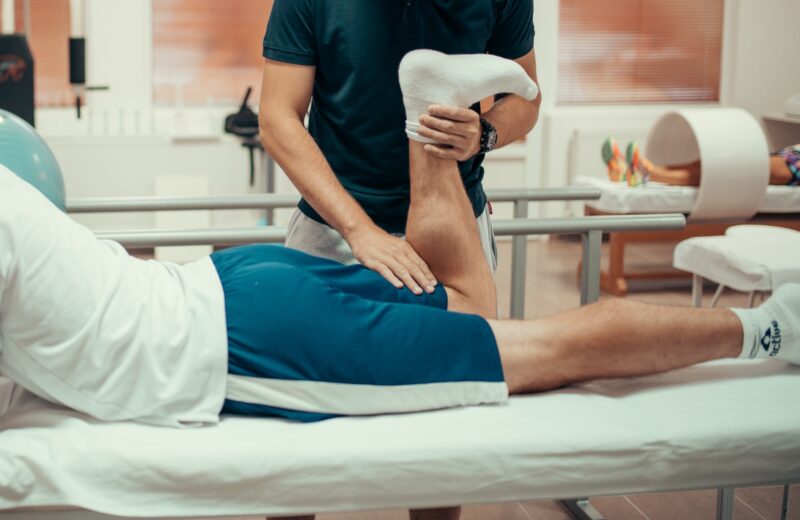
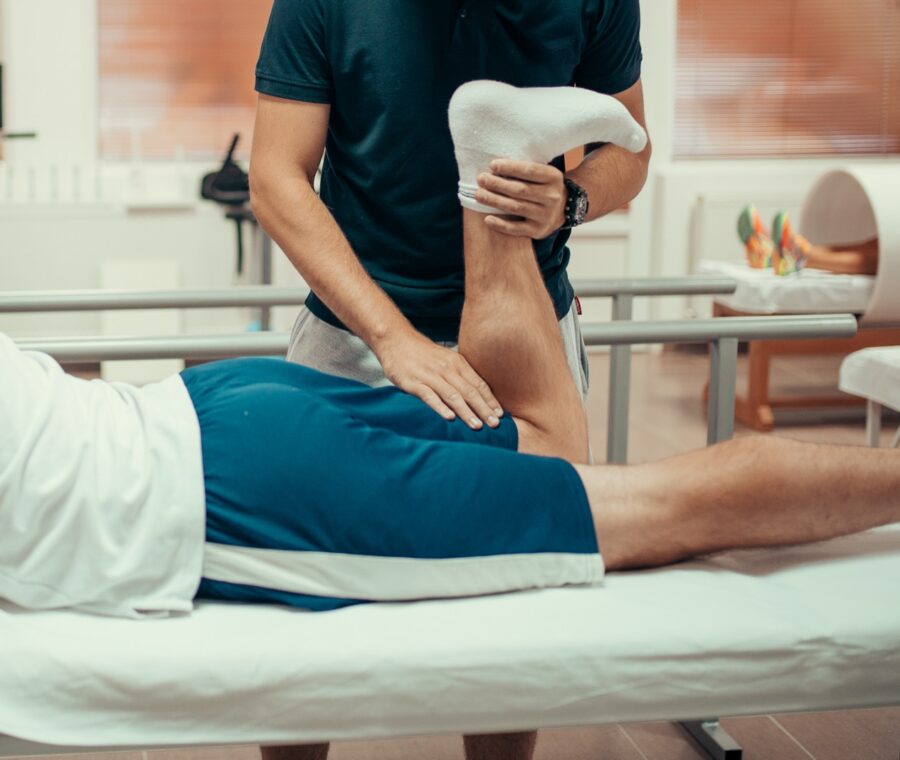
In the first two weeks, priorities are wound management, basic mobility, and safe movement patterns. Most patients have restrictions on hip flexion beyond ninety degrees and certain rotation directions, protecting the joint while soft tissue heals around the implant — these precautions vary depending on whether an anterior or posterior surgical approach was used. Physiotherapy at this stage focuses on bed mobility, sit-to-stand transfers, and walking with an aid, plus ankle pumps and gentle activation exercises to maintain circulation.
From two to six weeks, movement restrictions ease gradually and the exercise programme gets more active: restoring hip range of motion, beginning quadriceps and gluteal strengthening, progressing walking distance. This is also where the physiotherapist starts working on gait quality directly, catching abnormal patterns before they become ingrained habits.
From six weeks to three months, the programme steps up significantly. Gluteus medius strengthening becomes a primary focus, since this muscle is critical for pelvic stability during walking and stairs — weakness here is one of the most reliable causes of a persistent Trendelenburg gait after hip replacement. Hip extension strengthening, single-leg balance work, and step exercises are introduced progressively.
Clinical pilates on the reformer is introduced during this phase at Sevens. The reformer’s adjustable spring resistance allows lower limb strengthening in positions that respect the healing implant while still providing enough progressive loading to rebuild muscle properly. Supported positions — supine, side-lying, seated — allow work that would be difficult or unsafe in standing exercises this early.
From three to six months, the programme moves toward full daily activities: longer walks, stairs, car transfers, and for those who were active before surgery, a return to recreational activity. Balance and proprioception work matters here as patients learn to trust the new joint under more demanding conditions.
Gait Rehabilitation After Hip Replacement
Gait deserves specific attention, because walking better is what most people actually want out of this surgery, and abnormal patterns that developed before and during early recovery don’t always correct themselves without direct attention.
The Trendelenburg sign — a dropping of the pelvis on the unsupported side while walking — is a common post-operative finding reflecting gluteus medius weakness. Mild cases resolve as strength returns; more pronounced cases need specific strengthening and gait retraining to correct.
Other common issues include a shortened stride on the operated side (reduced hip extension and gluteal activation), increased reliance on trunk movement for forward progression instead of the hip extensors, and reduced walking speed relative to age-matched norms. A physiotherapist assessing gait after hip replacement identifies these specific features and addresses them through targeted exercise and, where needed, gait retraining that focuses on the coordination and timing of muscle activation, not just raw strength.
What Good Post-Hip-Replacement Physiotherapy Looks Like
Good rehab is progressive — it systematically increases in challenge as capacity improves. It’s individualised to pre-operative fitness, the specific surgical approach and its restrictions, and the patient’s functional goals. And it addresses the whole lower limb rather than the hip in isolation, since the knee, ankle, and lumbar spine all affect hip rehab outcomes — which is also why geriatric physiotherapy more broadly tends to think in terms of the whole kinetic chain rather than a single joint.
Importantly, good rehabilitation doesn’t plateau at “able to walk around the house” for someone who wants to get back to golf, swimming, or more demanding recreational activity. The programme should continue until the patient’s actual functional goals are met, not just the basic post-operative milestones — the same standard we hold for post-surgery rehab generally, whatever the joint involved.