There are patients who simply cannot begin rehabilitation on dry land. Someone who’s just had a total knee replacement and can’t bear their full body weight through the operated leg. A person with severe osteoarthritis whose joint pain stops them moving before the therapeutic exercise can even begin. An older adult with a neurological condition whose balance is too compromised to exercise safely on a stable surface.
Aquatic physiotherapy uses water’s buoyancy to cut the effective load through a joint to roughly a fifth of normal at chest depth — enabling movement, gait training and strengthening that’s impossible or too painful on land. It’s typically a bridge, not a permanent mode of rehab: as strength and tolerance build, the programme transitions back to land-based work. You don’t need to know how to swim; sessions are run in a shallow therapeutic pool in standing or supported positions.
For these patients, aquatic physiotherapy provides a starting point that land-based rehabilitation cannot. Water changes the mechanics of movement in clinically significant ways: buoyancy reduces the effective weight going through the joints to a fraction of the normal load, resistance is proportional to the speed of movement (making it naturally self-regulating), and warmth relaxes muscle spasm and increases tissue extensibility before movement even begins.
Used deliberately by a trained physiotherapist, these properties make aquatic physiotherapy one of the most effective tools available for early-stage rehabilitation, painful conditions, and populations where land-based exercise carries significant risk.
The Physical Properties That Make Water Therapeutic
Buoyancy acts as an anti-gravity force. When immersed to chest level, the effective body weight is reduced to approximately twenty percent of normal. This means someone who can’t walk comfortably on land, because the load through their painful joint is too great, can walk and exercise in a pool with only a fifth of that load — the difference between being able to begin rehabilitation or not.
Hydrostatic pressure, the pressure water exerts on all submerged surfaces, does two useful things: it reduces swelling by providing external compression that promotes fluid return from the limbs, and it feeds sensory information to the skin and joints that improves proprioception and balance.
Viscosity, water’s resistance to movement, means every movement performed in water requires muscular work proportional to the effort applied — pool exercise is therapeutic rather than passive, with the muscles working at a load that’s tolerable given the clinical presentation. Water temperature adds a further dimension: heated pools, typically kept between thirty-three and thirty-six degrees Celsius for physiotherapy, provide warmth that reduces muscle spasm and increases tissue extensibility, allowing movement that would be impossible or severely restricted in a cold or neutral environment. Many patients with chronic pain notice a meaningful reduction within the first few minutes of immersion.
Conditions That Benefit Most
Post-surgical rehabilitation is one of the primary applications at Sevens in HSR Layout. After hip or knee replacement, the patient can’t bear full weight through the operated limb until bone integration and soft tissue healing are far enough along. Aquatic physiotherapy allows gait training and muscle strengthening to begin earlier than land-based rehab permits — the patient builds strength and movement quality from an earlier point in recovery.
Severe osteoarthritis, where joint pain is limiting land-based exercise, benefits significantly from the reduced load in water. Exercise that’s impossible on land because of pain can often be performed comfortably in a heated pool, allowing the strengthening and range-of-motion work the condition needs but that pain has been preventing. Neurological conditions including stroke, multiple sclerosis, and Parkinson’s disease are treated with aquatic physiotherapy because water provides a safe environment for balance rehabilitation and gait retraining — the reduced risk of a harmful fall lets the patient challenge their balance in ways that would be unsafe on land, a principle that matters enormously for older patients generally.
Chronic pain conditions including fibromyalgia and chronic lower back pain respond well to the combination of warmth, buoyancy and gentle resistance that aquatic physiotherapy provides — the warm water reduces the pain sensitisation that makes movement difficult, allowing therapeutic exercise and movement retraining to begin. Acute lower limb injuries benefit from the same principle as post-surgical cases: the ability to begin loading and movement before full weight-bearing is appropriate on land, which is part of why it’s a standard tool across our broader post-surgery rehab work.
What a Session Involves
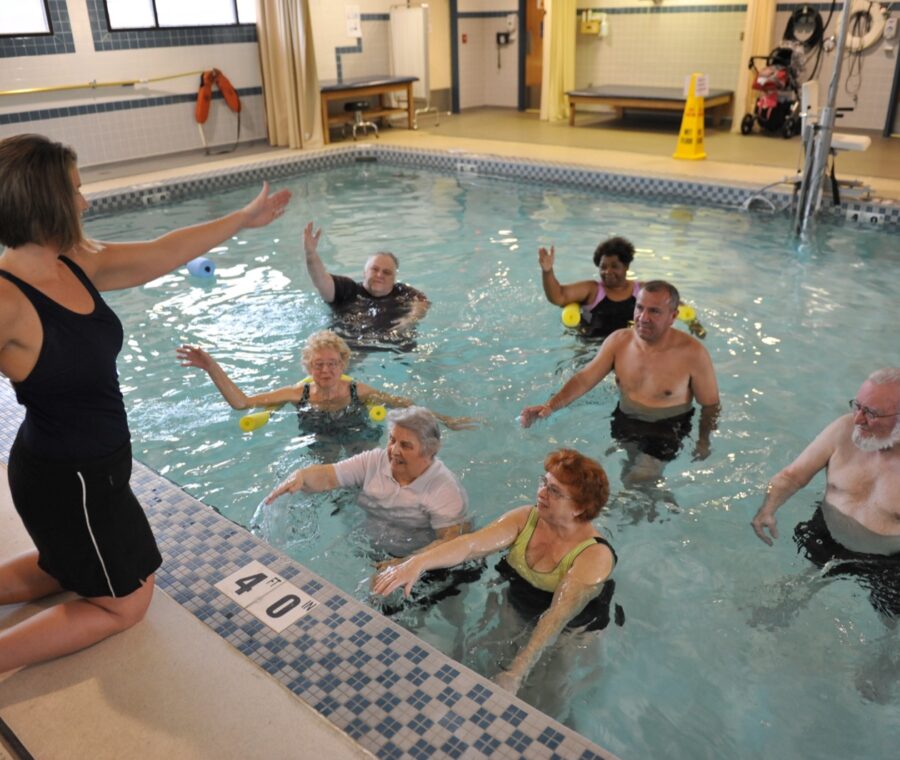
Sessions are conducted in a therapeutic pool maintained at an appropriate temperature for the clinical work. The physiotherapist assesses the patient on the pool deck before the session to review progress and set that session’s objectives, then enters the water with the patient or supervises from the pool edge depending on the patient’s independence level.
The content depends entirely on the clinical presentation. Gait retraining in water uses the same principles as land-based gait rehabilitation but in a reduced-load environment. Strengthening exercises use the water’s resistance and available pool equipment — buoyancy aids, resistance bands, floats — to provide progressive loading. Balance work uses the pool environment to challenge stability safely. Patients who aren’t confident swimmers aren’t disadvantaged: the therapeutic pool is typically shallow enough to stand in, and exercises are performed in standing or supported positions that don’t require swimming ability. Sessions are typically thirty to forty-five minutes — the physical demands of water-based exercise, combined with the cardiovascular load of a warm environment, are significant despite the lower joint loading.
The Transition to Land-Based Physiotherapy
Aquatic physiotherapy is typically used as a bridge, not a permanent mode of rehabilitation. As the patient builds strength, reduces pain, and tolerates increasing load, the programme transitions toward land-based exercise that more closely replicates the demands of daily life and sport.
This transition is gradual and guided by objective measures: pain levels during and after sessions, strength testing, gait assessment on land, and the patient’s confidence and function with daily activities. The goal is to reach a point where the patient can engage effectively with land-based rehabilitation and keep progressing without the pool. For some patients, particularly those with severe degenerative conditions or neurological presentations, aquatic physiotherapy remains a component of the long-term programme alongside land-based work rather than a temporary bridge.